Case Study
Digital Water City - EU Project
Brunnenlinse is revolutionizing the way that water well maintenance is managed. With Brunnenlinse as your CMMS, you will have access to the data you need, exactly where and when you need it.
- Client
- Berliner Wasserbetriebe
- Year
- - 2023
- Service
- Full-Stack Engineering, Mobile Applications

This solution comprises a software application for mobile devices that facilitates efficient data provision and collection in the field for drinking water well operation and maintenance. The application enables interoperability of data across various departments within utilities and across additional stakeholders, and eases data processing routines and visualisation of well condition characteristics. The solution will support utilities in shifting from time-based maintenance of single wells to condition-based maintenance with a view to all available wells and the target capacities of the utility.
Challenges
The management of drinking water abstraction assets is a complex and wide-reaching core activity of utilities. Well rehabilitation represents a major element of annual investments and expenses to maintain service quality. Wells are usually maintained based on condition and capacity data obtained from pumping tests (water levels, discharge rates) and CCTV inspections (ageing, corrosion, etc.).
A decrease below 80% of initial capacity or poor physical condition are seen as triggers for maintenance. Scheduling of monitoring activities is typically based on long-term practical experience of waterworks staff. Over the years, regular intervals were established, enabling time-based maintenance of single wells. Utilities are lacking methodologies to prioritise operation and maintenance, however, and could benefit from making greater use of sensors and loggers making larger volumes of data available at the right time and in the right location. Moreover, solutions must be viable and attractive to field staff and lead to a reduction in workload, instead of adding complexity to the process.
Limitations of current practices
Well and groundwater data are collected by various stakeholders such as water utilities or environmental authorities.
They describe the maintenance, operation and condition of the assets and the aquifer and are usually available in several databases or in paper form. Field work is still often recorded offline and manually integrated in company databases. Utilities lack solutions to support efficient and secure data collection on-site. They might consider using digital devices and applications to improve the efficiency of procedures but remain concerned with cybersecurity issues linked to critical infrastructure.
Innovation
Efficient data integration in the data management systems of utilities and authorities is the key to allow further data analysis such as semi-automated well condition assessment and groundwater level monitoring.
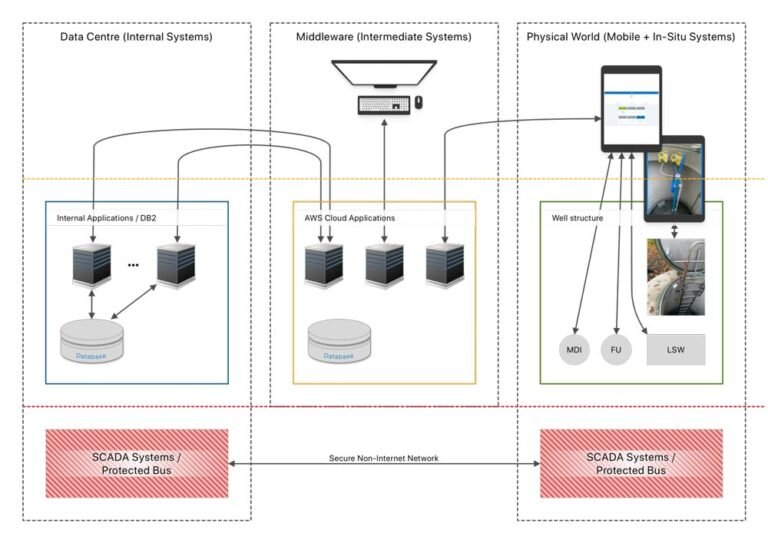
The solution will facilitate the use of different sources of data for field work, and will automatically validate and transfer the collected data to the utility database(s). Having this data readily available will reduce operating expenditure by accelerating maintenance procedures and focusing activities on wells with the highest maintenance needs. It will improve decision making by using available data and machine learning algorithms for automatic well condition assessment, and for the elaboration of cost-efficient maintenance plans to efficiently allocate long-term investments for well rehabilitation and replacement. This tool will be developed as a modular solution with open-source components, building on existing tools for long term management of sewer and drinking water networks.
City tests
The solution is being deployed in Berlin to improve the data collection and management of drinking water wells. It is implemented at the city scale (about 650 groundwater wells) with a focus on wells at risk (shallow, unconfined, bank filtrate wells).
Any maintenance of drinking water wells includes documentation in a central well database. The “DW Well Diary” allows direct input into the well database and eliminates the need for paper documentation and later transfer to the database.
The error-prone manual transfer of data to from paper to a database is replaced by direct data entry in the field. Based on the estimated number of data entries per year and an average error rate during manual data transfer, the number of data errors prevented by implementation of the DS is calculated.